

Quick Answer
Custom promotional products can be decorated using screen printing, pad printing, embroidery, laser engraving, full color digital printing, transfers, sublimation, debossing, embossing, and other methods. The best choice depends on the product, material, logo, imprint area, quantity, and desired appearance. Not every decoration method is available on every product. Purple Pie Promos reviews your artwork and selected decoration options before production and can help identify potential issues or recommend alternatives when appropriate.
Putting a logo on a promotional product sounds straightforward, but the process can be surprisingly different depending on the item.
Printing a logo on a cotton tote bag is not the same as decorating a stainless steel tumbler. Embroidering a polo shirt is different from printing a t-shirt. A logo that fits perfectly on a notebook may be too detailed for a pen.
Even the word "printing" can be confusing because the promotional products industry uses many different decoration processes, some of which do not involve ink at all.
This FAQ explains how custom decoration works, what affects your options, and how to choose the right approach for your merchandise.
How Are Logos Printed on Promotional Products?
Logos are applied to promotional products using decoration methods designed for the specific item and material.
Some methods apply ink directly to a surface. Others transfer a printed design, stitch artwork with thread, engrave the material, or create a raised or recessed impression.
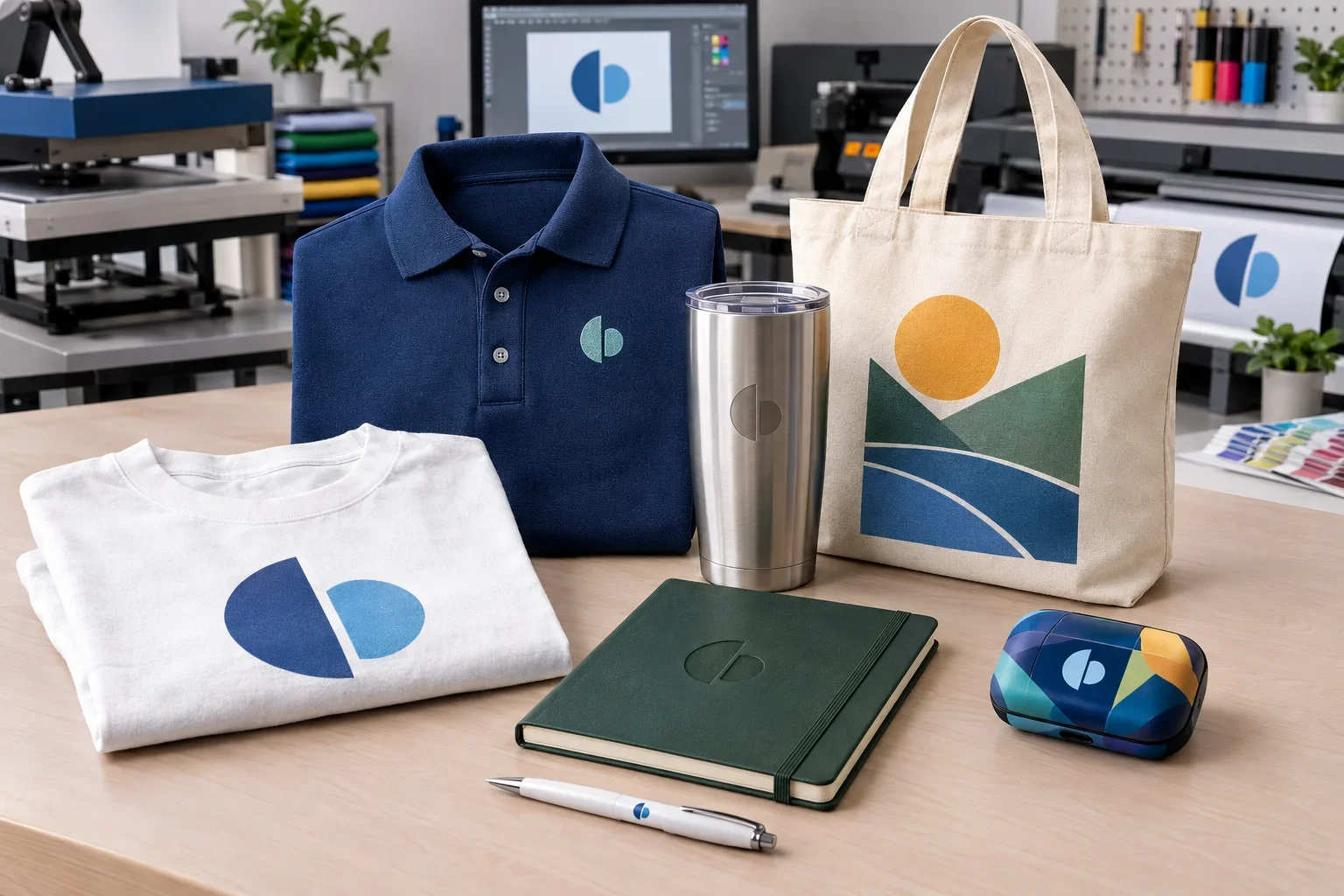
For example, a cotton tote bag might be screen printed. A stainless steel tumbler might be laser engraved. A polo shirt might be embroidered. A plastic pen might be pad printed, while a notebook might be decorated using full color printing or debossing.
The available methods depend on the exact product. Two similar-looking items may offer different customization options because of their materials, finishes, shapes, or supplier capabilities.
What Is a Decoration Method?
A decoration method is the process used to customize a promotional product with your logo, artwork, name, or message.
Different decoration methods produce different results. Some create a flat printed design, while others add texture, dimension, or a more subtle finish.
Common Promotional Product Decoration Methods
Each method has different strengths depending on the product and artwork.
Screen Printing
Applies ink through a prepared screen. Common for t-shirts, tote bags, and products with suitable printing surfaces.
Pad Printing
Transfers ink using a flexible pad. Useful for pens, small hard goods, and certain curved or irregular surfaces.
Full Color Printing
Reproduces detailed artwork, photographs, gradients, and designs with many colors on compatible products.
Embroidery
Uses thread to stitch a logo into fabric. Popular for polos, hats, jackets, bags, and professional apparel.
Laser Engraving
Marks or removes material from a product surface. Common for stainless steel drinkware, metal pens, tools, and awards.
Transfers
Applies a prepared design to a compatible product, often using heat and pressure. Common for detailed apparel graphics.
Debossing
Presses artwork into a material to create a recessed design. Often used on notebooks, padfolios, and premium accessories.
Embossing
Creates a raised impression on compatible materials for a dimensional, tactile appearance.
Dye Sublimation
Uses heat to transfer dye into compatible materials. Useful for full color designs on certain fabrics and coated products.
For a more detailed explanation, read Which Decoration Method Should I Choose? or explore our Decoration Methods resource.
Can I Choose Any Printing Method for My Product?
Not necessarily. Each promotional product supports specific decoration methods based on its material, construction, and available production equipment.
For example, a stainless steel bottle may offer laser engraving, screen printing, or full color decoration. A cotton t-shirt may support screen printing, direct-to-garment printing, or transfers. A notebook might offer debossing, foil stamping, or printing.
However, the specific methods available depend on the exact item.
If a product offers several decoration methods, you can compare the different finishes and pricing before choosing.
At Purple Pie Promos, we review the decoration method selected for your order. If another method appears more suitable for your artwork, we can discuss the available options before production rather than changing the method without your approval.
What Is the Difference Between Screen Printing and Full Color Printing?
Screen printing and full color printing are both used to decorate promotional products, but they reproduce artwork differently.
Traditional screen printing is often used for solid-color designs. Depending on the product, each imprint color may require its own prepared screen and printing pass.
Full color printing uses processes designed to reproduce a broad range of colors, including gradients, shading, and photographic details.
For example, a simple one-color company logo may be ideal for screen printing on a tote bag. A complex design containing several colors, shadows, and detailed artwork may be better suited to a compatible full color method.
Screen Printing vs. Full Color Printing
The right method depends on the product, artwork, and available decoration options.
Traditional Screen Printing
- Often best for simpler artwork
- Commonly uses solid ink colors
- Additional colors may require additional setup
- Popular for apparel, bags, and compatible hard goods
- May have color-count restrictions
Full Color Printing
- Useful for detailed or colorful artwork
- Can reproduce gradients and photographs
- Does not usually price each visible color separately
- Available on select apparel, bags, drinkware, and hard goods
- May have material or color-matching limitations
Learn more in Full Color Digital vs. Full Color Transfer and Screen Printing vs. Transfers.
Can I Print My Logo in Full Color?
Yes, many promotional products support full color decoration.
Full color printing is particularly useful when your artwork contains several colors, gradients, photographs, shading, or complex graphics.
Depending on the product, full color decoration may be available through digital printing, transfers, decals, sublimation, or other processes.
However, full color decoration is not available on every product. The surface material, shape, available equipment, and supplier capabilities determine what can be reproduced.
It is also important to understand that full color printing does not automatically guarantee exact Pantone color matching.
Can I Print a Photograph on a Promotional Product?
Sometimes. Photographs can be reproduced on products that support suitable full color printing methods.
Examples may include select mugs, notebooks, mouse pads, apparel, blankets, and other products designed for detailed graphics.
The photograph must have enough resolution to print clearly at the intended size.
A small photograph copied from a website or social media page may not have sufficient quality for a large imprint.
The finished appearance can also depend on the product material and printing process.
Can Gradients and Shading Be Printed?
Yes, but not with every decoration method.
Gradients are gradual transitions between colors. Shading adds depth or variation within artwork.
These effects can often be reproduced using full color digital printing, transfers, sublimation, and other compatible processes.
Traditional spot color printing, embroidery, laser engraving, and debossing may have different limitations.
If your logo contains gradients or shading, the decoration method becomes especially important.
Why Can't Every Logo Be Screen Printed?
Some logos contain more colors, detail, or complexity than the available screen printing process can reproduce effectively.
Small lettering, thin lines, gradients, shadows, and photographic elements may be difficult or impractical with certain screen printing methods.
Some promotional products also limit screen printing to one color or a small imprint area.
For example, a colorful logo that looks excellent on a computer screen may need a full color transfer rather than a one-color screen print on a tote bag.
For more detail, read Why Can't Every Logo Be Screen Printed?.
What Is an Imprint Area?
An imprint area is the space on a promotional product where your logo or design can be applied.
Every product has different imprint limitations based on its dimensions, material, construction, and decoration method.
For example, a pen may only have a narrow space along its barrel. A tote bag may provide a larger flat area. A hat may have restrictions caused by seams, panels, and curvature.
The imprint area can also change depending on the selected decoration method.
A tumbler may have one imprint area for screen printing and a different area for laser engraving or full color decoration.
How Large Can My Logo Be Printed?
The maximum logo size depends on the product and available imprint area.
Some products allow large, prominent graphics. Others are better suited to smaller logos or simplified designs.
A wide logo may fit comfortably on a tote bag but become difficult to read when reduced for a pen or keychain.
Even when artwork technically fits within the imprint area, very small details may not reproduce clearly.
For more information, read How Large Can My Logo Print?.
Can I Print My Logo Anywhere on a Product?
Not necessarily. Promotional products generally have designated imprint locations supported by the manufacturer or decorator.
These locations are selected based on the product's construction, available equipment, decoration surface, and production requirements.
For example, a polo shirt may offer left-chest embroidery, sleeve decoration, or other approved locations. A tumbler may have front, back, or wraparound options. A tote bag may support printing on one or both sides.
The available locations vary by item.
If you have a particular placement in mind, review the imprint options for the specific product before finalizing your order.
Can I Print on Both Sides of a Promotional Product?
Sometimes. Many products offer more than one imprint location.
For example, a t-shirt might be printed on the front and back. A tote bag might support decoration on both sides. A tumbler may offer multiple imprint positions or an expanded wrap decoration.
However, additional imprint locations are not available on every product.
When multiple locations are available, they may involve additional setup charges, decoration costs, or production time.
Before ordering, confirm which imprint locations are offered and whether they meet your needs.
What Is Wraparound Printing?
Wraparound printing places artwork around a larger portion of a product's surface rather than limiting the design to a small front-facing area.
This option is especially common on certain drinkware products, although availability depends on the item and decoration method.
Some products offer a full color wrap, while others may support an expanded screen print or laser engraving area.
Wraparound decoration can provide more room for logos, patterns, and messaging.
However, a wrap imprint does not always mean the entire product surface can be decorated without seams, gaps, or other limitations.
The exact coverage should be reviewed for the selected product.
Can My Logo Cross a Seam, Handle, or Curved Surface?
Sometimes, but seams, handles, edges, and curved surfaces can restrict where decoration can be applied.
For example, a tote bag's seams may limit the available printing area. A tumbler handle may interrupt a wrap imprint. Apparel seams and pockets can affect printing or embroidery placement.
These limitations exist because decoration equipment needs enough access to the product surface to apply the design accurately.
If you want artwork to extend close to an edge, seam, or handle, ask whether that placement is possible before approving the proof.
Can I Use Different Logos on Different Imprint Locations?
Sometimes. A product may support different artwork on separate imprint locations.
For example, a shirt might feature a company logo on the front and an event design on the back. A tote bag might have a logo on one side and a sponsor message on the other.
However, each design may require separate artwork preparation, setup, proofing, or decoration charges.
The available options depend on the product and decoration method.
Planning multiple imprints?
Share all artwork and placement requirements at the beginning of your project. It is easier to prepare an accurate quote and proof when every imprint location and design is known before production.
Can I Print on Different Materials?
Yes. Promotional products can be customized on a wide variety of materials, including fabric, metal, plastic, glass, ceramic, paper, leatherette, and wood.
However, each material requires compatible decoration methods.
Common Materials and Decoration Options
These are common pairings. Actual options depend on the specific product.
Cotton & Fabric
Screen printing, transfers, embroidery, DTG, DTF, or sublimation on compatible fabrics.
Stainless Steel
Laser engraving, screen printing, pad printing, and select full color methods.
Plastic
Pad printing, screen printing, full color digital printing, decals, or other compatible methods.
Glass & Ceramic
Screen printing, decals, specialty printing, etching, or other methods depending on the product.
Paper & Notebooks
Full color printing, screen printing, debossing, embossing, or foil stamping.
Leatherette & Wood
Laser engraving, debossing, foil stamping, or specialty decoration on compatible products.
The key is choosing a decoration process suited to the material rather than assuming one printing method will work on everything.
Can You Print on Stainless Steel Tumblers?
Yes. Many stainless steel tumblers support custom decoration.
Common options may include laser engraving, screen printing, and full color printing, depending on the item.
Laser engraving is popular because it creates a clean, professional appearance by marking or removing part of the surface coating.
Printed decoration may be a better choice when your logo requires specific ink colors or a colorful design.
Some tumblers also offer expanded imprint areas or wraparound decoration.
The available options depend on the tumbler's finish, shape, and manufacturer.
Can You Print on Tote Bags?
Yes. Tote bags are among the most common custom printed promotional products.
Depending on the bag's material and construction, decoration options may include screen printing, transfers, full color printing, or embroidery.
A simple one-color logo may work well with screen printing on a cotton tote.
A colorful design with gradients or detailed artwork may be better suited to a compatible full color transfer or digital method.
The available imprint area depends on the bag's dimensions, seams, handles, pockets, and material.
For product selection advice, read Best Custom Tote Bags.
Can You Print on T-Shirts and Hoodies?
Yes. T-shirts, hoodies, sweatshirts, and other apparel are commonly customized using screen printing, transfers, direct-to-garment printing, and direct-to-film printing.
The best method depends on the fabric, garment color, design, quantity, and desired appearance.
Simple artwork with solid colors may work well with screen printing.
More detailed designs, photographs, or artwork containing many colors may be better suited to a full color method.
Some fabrics, blends, and garment finishes have special decoration requirements.
For more detail, read Screen Printing vs. DTG vs. DTF.
Can You Embroider Any Logo?
Not every logo can be embroidered exactly as originally designed.
Embroidery uses thread rather than ink, so detailed artwork may need to be simplified before it can be stitched clearly.
Small text, very thin lines, gradients, and intricate shapes can create challenges.
For example, a logo with a small slogan underneath may look excellent on a printed notebook but become difficult to read when embroidered on a polo shirt.
In some cases, removing tiny text or using a simplified logo version produces a cleaner finished result.
Learn more in Embroidery vs. Screen Printing.
Can Laser Engraving Reproduce My Logo Colors?
Traditional laser engraving does not reproduce a logo using full color inks.
Instead, the laser marks or removes part of the product surface.
The resulting appearance depends on the material and coating. For example, engraving a powder-coated stainless steel tumbler may expose the underlying metal.
On other materials, engraving may create a darker, lighter, or tone-on-tone appearance.
If your logo requires specific brand colors, a printed decoration method may be more appropriate.
What Is the Difference Between Debossing and Embossing?
Debossing creates a recessed design by pressing artwork into a compatible material.
Embossing creates a raised design that extends above the surrounding surface.
Both methods are commonly associated with notebooks, folders, packaging, and other products where a dimensional or textured appearance is desired.
They can create an understated, premium finish without relying on traditional printed ink.
For more information, read Deboss vs. Emboss.
Can I Use the Same Logo on Different Products?
Yes. A company can use the same logo across many promotional product categories.
However, the artwork may need to be resized or adapted for the different imprint areas and decoration methods.
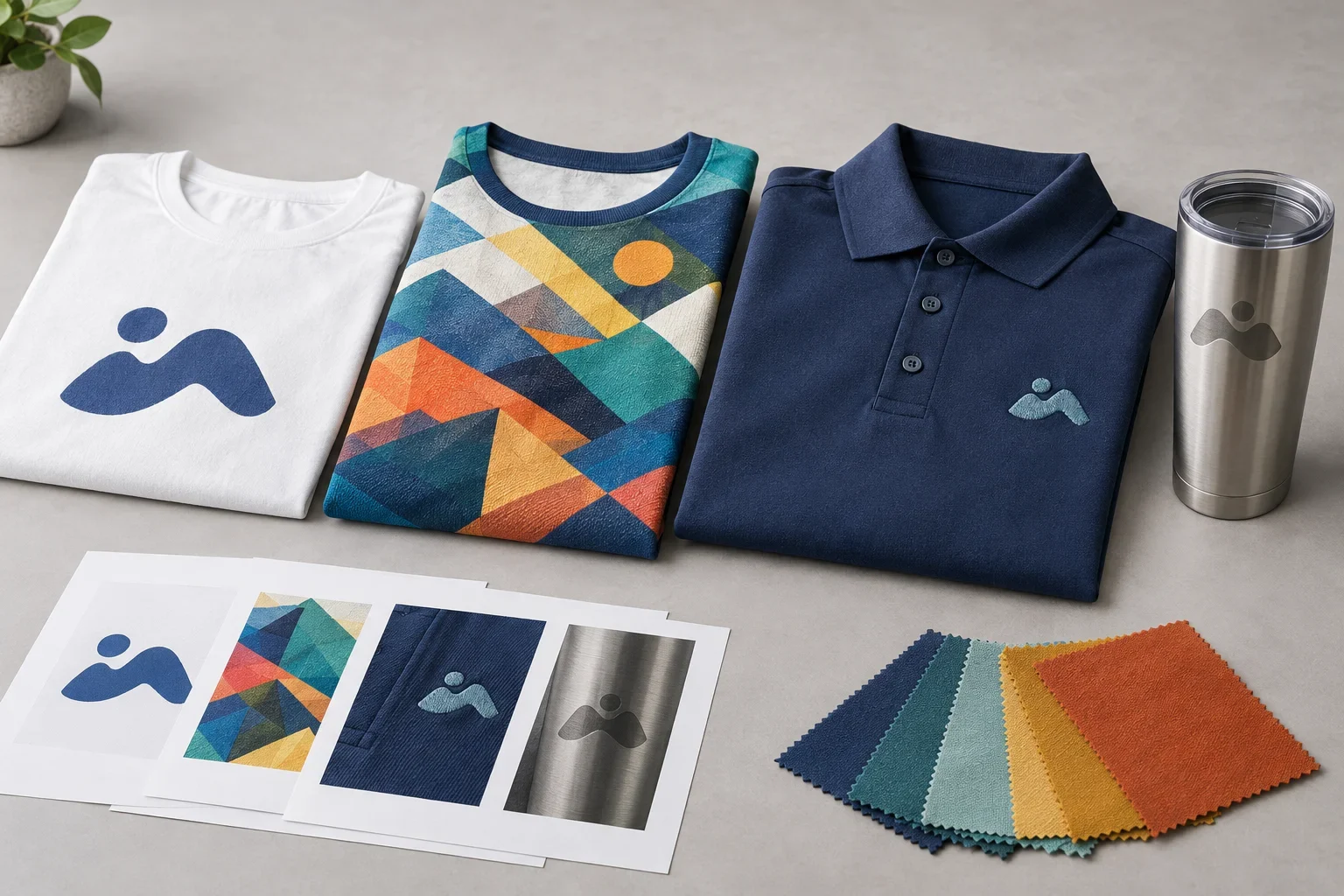
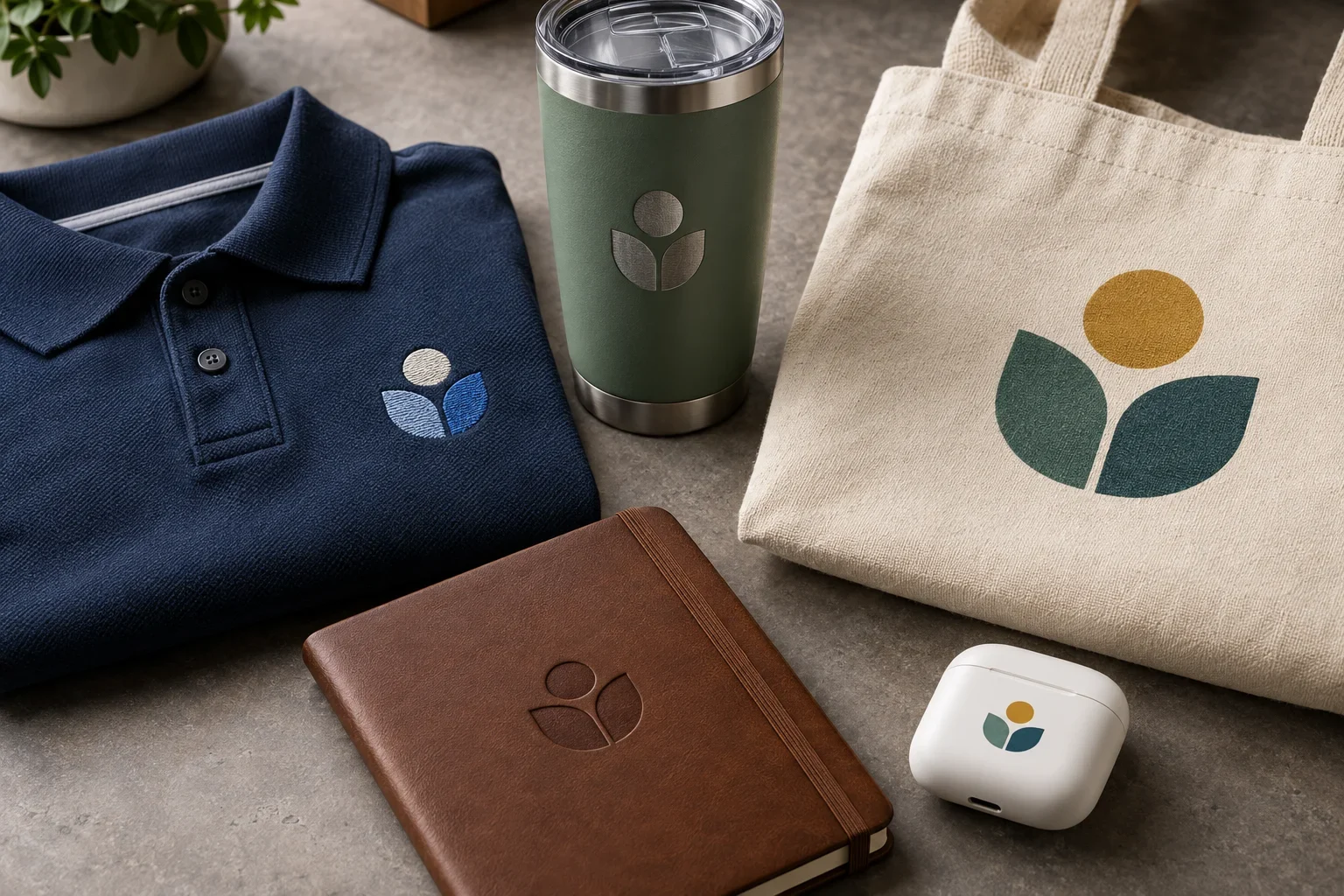
For example, a full color logo might be printed on a notebook, converted to a one-color version for a pen, embroidered on a polo, and engraved on a tumbler.
Each version can still represent the same brand while respecting the limitations of the selected product.
If your company has multiple approved logo variations, such as horizontal, stacked, one-color, and icon-only versions, those files can be helpful when decorating different merchandise.
Can I Use Different Logo Colors on Different Products?
Yes. Many companies use different approved versions of their logo depending on the product color and decoration method.
For example, a dark logo may work well on a light-colored notebook, while a white version may be more visible on a dark tote bag.
An embroidered logo may use available thread colors, while engraving creates its appearance through the product material rather than ink.
Using different logo versions can help maintain visibility and recognizable branding across different products.
Can You Match My Brand Colors Exactly?
Color matching may be possible depending on the product and decoration method.
Pantone colors can help communicate specific brand color targets for compatible printing processes.
However, exact matches are not always possible across different materials, inks, threads, coatings, and production methods.
For example, the same brand color may appear different when printed on cotton, applied to plastic, or embroidered with thread.
If brand colors are important, provide your Pantone references or original brand guidelines when requesting your quote.
For more information, read our Color FAQ and Can You Match My Brand Colors?.
What Artwork File Is Best for Custom Printing?
For most logos, vector artwork is preferred because it can be resized without becoming blurry.
Common vector file formats include AI, EPS, SVG, and certain PDF files.
However, not every PDF contains vector artwork. A low-resolution image saved inside a PDF is still a low-resolution image.
High-resolution PNG or JPG files may work for some full color printing methods, depending on the intended print size and artwork.
If you are not sure what file to send, provide the best version you have.
Purple Pie Promos can review your artwork and let you know if another file or adjustment is needed before production.
Learn more in What Is Vector Artwork?.
Can I Use a Screenshot or Website Logo for Printing?
A screenshot or small website logo may be useful as a reference, but it is often not suitable for production.
Images copied from websites, email signatures, and social media are frequently compressed or saved at relatively low resolutions.
When enlarged for printing, those images may become blurry or pixelated.
Sometimes the artwork can be recreated or improved, but the best solution is usually to locate the original high-quality logo file.
For more guidance, read Why Does My Logo Look Blurry?.
Can You Print Small Text and Fine Details?
Sometimes, but every decoration method has limits on how small lettering and fine details can be reproduced.
A detailed logo that looks clear on a large computer screen may become difficult to read when reduced to fit a pen, keychain, cap, or other small product.
Embroidery may struggle with tiny lettering because thread has physical thickness. Screen printing and other ink-based methods can also have minimum line and text requirements.
If a logo contains very small details, simplifying the artwork or selecting a product with a larger imprint area may produce a better result.
Can You Add Individual Names to Promotional Products?
Personalization may be available on certain products and decoration methods.
For example, some products may support individual employee names, titles, initials, or other variable information.
Personalization is often associated with engraving, embroidery, digital printing, and certain specialty decoration methods, depending on the product.
However, not every item supports individual customization.
Personalized orders may also require additional setup, proofing, production time, or pricing.
If your project involves individual names, provide the requirements early so the available options can be reviewed.
Can You Print Different Designs Within the Same Order?
Sometimes. The ability to use multiple designs depends on the product, supplier, decoration method, and minimum order requirements.
For example, you might want one logo for a sales department and another for an operations department.
Each unique artwork version may require separate setup, proofing, or production handling.
Some products may allow multiple designs within an order, while others require separate minimum quantities.
When requesting a quote, explain how many different designs you need and the quantity of each version.
Do Different Product Colors Require Different Printing Setups?
Not always.
Some products allow the same logo and imprint color to be used across several product colors without requiring a completely separate decoration setup.
Other products or suppliers may have additional requirements depending on the material, production process, or color combination.
For example, printing the same white logo on several dark-colored tote bags may be simpler than printing different logo colors on each bag.
If you want to mix product colors, provide the breakdown before finalizing the order so the pricing and decoration requirements can be reviewed.
Why Does Adding More Print Colors Sometimes Cost More?
Some decoration methods require separate production steps for each ink color.
Traditional screen printing is a common example. Depending on the design, each additional color may require another screen, registration, and printing pass.
However, other methods such as full color digital printing or full color transfers are designed to reproduce many colors within the same process.
This means the number of colors does not affect pricing in the same way for every decoration method.
For more information, read Why Does Each Print Color Cost More?.
Does a Larger Logo Cost More to Print?
Sometimes. The effect of logo size on pricing depends on the decoration method and product.
Some products have standard imprint pricing that covers artwork fitting within the available imprint area.
Other methods may have different prices based on imprint dimensions, the amount of decoration material used, or production requirements.
Embroidery is a good example because larger or more detailed designs may require additional stitches.
For screen printing and transfers, larger artwork may require different equipment, materials, or imprint configurations.
The actual pricing should be reviewed for the specific product and method.
What Is a Setup Charge?
A setup charge covers certain preparation work required before decorating the merchandise.
Depending on the method, setup may include preparing artwork, creating screens, configuring printing equipment, digitizing an embroidery design, or preparing engraving instructions.
Some products include setup in their pricing, while others list it separately.
Setup charges may vary depending on the number of designs, imprint colors, or decoration locations.
For more information, read our Pricing FAQ.
Is There a Minimum Quantity for Custom Printing?
Many promotional products have minimum order quantities.
Minimums depend on the supplier, product, decoration method, and production requirements.
Some items are available in relatively small quantities, while others require larger production runs.
Different decoration methods can also have different minimum quantities for the same general type of product.
If you only need a small number of customized items, share your quantity early so suitable options can be explored.
Can I Print Only One Custom Item?
Sometimes, but single-piece customization is not available for every promotional product.
Many suppliers use minimum quantities because they must prepare production equipment and artwork before decorating the merchandise.
Some digital printing, engraving, or personalization services may support lower quantities, depending on the specific product.
If you need just one item, ask about available low-minimum options rather than assuming every product can be ordered individually.
Can I See a Proof Before My Products Are Printed?
Yes. At Purple Pie Promos, you have the opportunity to review an artwork proof before your order goes into production.
The proof helps show how your logo or design is expected to appear on the selected product.
It may include the imprint location, approximate size, artwork layout, and decoration information.
Review the proof carefully to make sure the correct artwork, spelling, placement, and product details are shown.
A digital proof is not always an exact representation of the finished product's material, texture, or color.
For more information, read our Proofs FAQ.
Can I Request Changes to the Printing Before Production?
Yes. If something in your quote or artwork proof needs adjustment, contact Purple Pie Promos before giving final approval.
For example, you may want to change the logo size, imprint location, artwork version, product color, or decoration method.
Some changes are straightforward, while others may affect pricing, product availability, or production time.
The important thing is to resolve those details before the order moves into production.
Nothing gets decorated without your approval
At Purple Pie Promos, requesting a quote and proof starts the review process, not production. You can ask questions, discuss decoration options, and request changes before approving your final sales confirmation. Production begins after final approval and payment.
Will the Final Printed Product Look Exactly Like the Proof?
The proof is a visual representation of how your artwork is expected to appear, but it may not show every physical characteristic of the finished decoration.
Fabric texture, embroidery thread, engraving depth, material color, surface curvature, and lighting can affect the final appearance.
For example, an embroidered logo will have a different texture from its flat digital representation. A laser engraved design may appear in the underlying material color rather than the color shown on your screen.
If an aspect of the finished appearance is especially important, ask about the available options before approval.
How Durable Is Custom Printing?
Decoration durability depends on the method, product material, surface preparation, manufacturing quality, and how the item is used and cared for.
Screen printing, embroidery, engraving, transfers, sublimation, and other methods have different durability characteristics.
For example, embroidery is often a good choice for apparel that receives regular wear. Laser engraving can create a durable mark on many metal products because it alters the product surface rather than applying ink.
Printed decorations can also be durable when applied correctly, but their performance depends on the specific process and product.
No single decoration method is automatically the most durable for every material or use case.
Will Custom Printing Fade, Peel, or Wear Off?
Some decoration methods can experience wear over time, depending on the product and how it is used.
For example, repeated washing, abrasion, heat, chemicals, or rough handling can affect certain printed or transferred designs.
Embroidery and engraving behave differently because they use thread or alter the product surface rather than applying a conventional printed layer.
However, even durable decoration can be affected by extreme conditions or improper care.
It is important to follow the care instructions provided for the specific product.
Can Custom Printed Drinkware Go in the Dishwasher?
That depends on the product and decoration method.
Some promotional drinkware is designed to be dishwasher safe, while other products require hand washing to protect the material, coating, insulation, or decoration.
A product's blank construction and its custom imprint may have different care considerations.
Do not assume that every printed or engraved tumbler, bottle, or mug is dishwasher safe.
Review the care instructions for the specific product before washing.
Can You Print on Products I Already Own?
Custom decoration services in the promotional products industry are generally designed around merchandise supplied through the participating manufacturer or decorator.
Printing on customer-supplied items may not be available because of material compatibility, equipment requirements, liability concerns, and the risk of damaging products that cannot be replaced.
If you have a specific product you want customized, contact Purple Pie Promos to discuss the item and whether a comparable product is available through our suppliers.
Can I Provide My Own Artwork or Design?
Yes. Customers commonly provide their own logos, artwork, event graphics, and other designs for promotional products.
The artwork must be suitable for the selected product and decoration method.
Original vector files are often preferred for logos, while high-resolution raster artwork may be appropriate for some full color printing methods.
If you are using artwork that belongs to another company, organization, or creator, make sure you have permission to reproduce it.
Purple Pie Promos can review the technical suitability of the file and identify potential decoration limitations before production.
Can You Help If I Don't Know Which Printing Method to Choose?
Yes. You do not need to be familiar with every decoration process before ordering promotional products.
If you know which item you want and have a logo, that is often enough to begin discussing your options.
Purple Pie Promos can help review the available imprint methods, artwork requirements, color limitations, and finished appearance for your selected product.
For example, if your logo contains several colors and the product offers both screen printing and full color transfer, we can help explain the differences so you can make an informed choice.
The goal is to find a method that works for your artwork and product rather than making you guess your way through printing terminology.
Common Custom Printing Mistakes
Many customization issues happen when artwork, product materials, and decoration methods are not matched correctly.
- Choosing a decoration method without reviewing the product's available options
- Assuming every product supports full color printing
- Using artwork that is too detailed for the imprint area
- Expecting embroidery or engraving to reproduce a full color logo exactly
- Trying to print across seams, handles, or other restricted areas
- Assuming a wrap imprint covers every part of the product without limitations
- Sending low-resolution screenshots instead of original artwork
- Not considering contrast between the product color and logo color
- Adding multiple imprint locations without reviewing additional charges
- Assuming different decoration methods will produce identical finishes
- Approving a proof without checking spelling, placement, or artwork size
- Waiting until after production begins to request changes
What Should I Check Before Approving Custom Printing?
Before your order moves into production, review the product and decoration details carefully.
Custom Printing Approval Checklist
Make sure the product, artwork, and decoration method work together.
The Bottom Line
Custom promotional product printing involves more than simply placing a logo on an item.
The product material, available imprint area, artwork quality, decoration method, quantity, and desired appearance all influence how the finished merchandise can be customized.
Screen printing, full color printing, embroidery, engraving, transfers, debossing, embossing, and other methods each have different advantages and limitations.
The best approach is to choose a product that fits your needs, review the available decoration methods, and confirm that your artwork will reproduce appropriately before production begins.
The right logo, on the right product, with the right decoration
Great custom promotional products start with matching your artwork to the product and its available decoration options.
You do not need to know every printing method before ordering. Purple Pie Promos can help review your options and guide you through the details before production.
Need help with custom printing or logo placement?
Purple Pie Promos can help you review the available decoration methods, imprint locations, artwork requirements, and pricing for your selected promotional products. Whether you have a simple one-color logo or a detailed full color design, we can help you understand your options before you order.
Ask About Custom Printing