

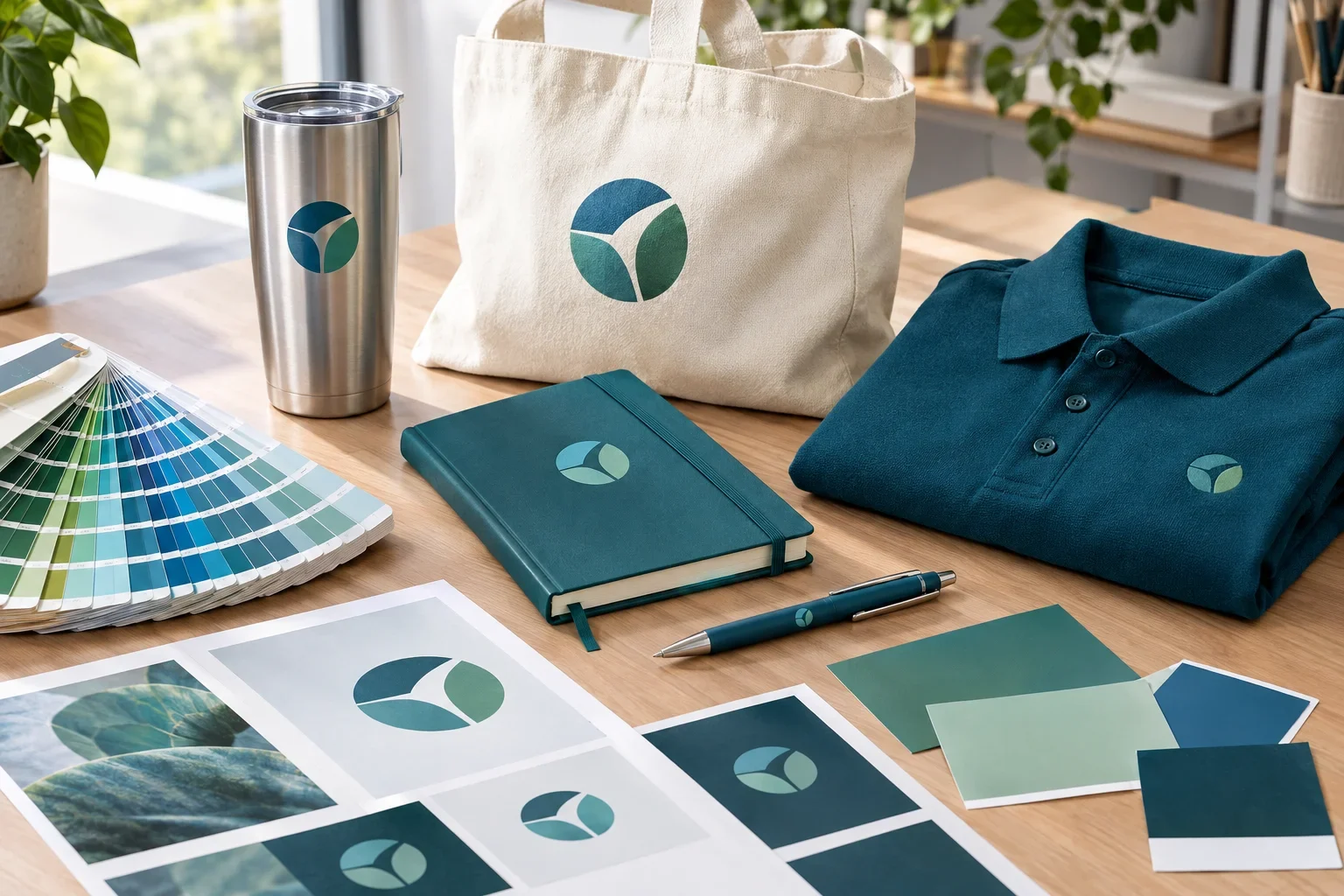
Quick Answer
Yes, brand colors can often be matched closely on promotional products, but an exact match is not always possible. Some products and decoration methods support custom Pantone (PMS) ink matching, while others use standard imprint colors, digital printing, or embroidery thread. The final appearance depends on the product material, surface color, printing process, and available decoration options. Providing your official Pantone colors or brand guidelines gives the decorator the best starting point for achieving a consistent result.
Let's say your company has a very particular shade of blue.
It's on your website, your business cards, your signs, and every piece of marketing material your company produces. Your customers recognize it. Your employees recognize it. It's part of what makes your brand look like your brand.
Now you're ordering promotional products for an upcoming event.
You want blue logos printed on white pens, embroidered on navy polos, and printed on stainless steel tumblers.
Can everything match?
The answer is that we can often get very close, but the possibilities depend on the products and how they're decorated.
The same blue ink does not necessarily look identical on plastic, fabric, coated metal, and paper. And embroidery doesn't use ink at all.
Understanding these differences can help you choose products and decoration methods that keep your branding looking consistent without expecting every material to behave the same way.
What Does Brand Color Matching Actually Mean?
In promotional product printing, color matching means trying to reproduce a particular color as closely as the available decoration process allows.
Sometimes that involves mixing ink to match a specific Pantone reference. Other times, it means selecting the closest standard ink or thread color available.
For full color printing, the process may involve converting artwork colors into the colors the printing equipment can reproduce.
These are different approaches, and they don't all offer the same level of precision.
Matching the color vs. matching the appearance
Two products can use the same specified brand color and still look slightly different. Matching a color reference is one part of the process. The physical material, finish, and decoration method also influence how that color appears.
Why Pantone Colors Are Helpful
If your business has official Pantone colors, those are among the most useful details you can provide when ordering promotional products.
The Pantone Matching System, often called PMS, provides standardized color references used throughout the printing industry.
Instead of saying your logo is "dark blue" or "a bright reddish orange," you can provide a specific Pantone number.
For example, your brand guidelines might identify a particular blue as PANTONE 286 C.
That gives the decorator a defined color target rather than leaving someone to interpret the shade from a computer screen.
However, providing a Pantone number doesn't automatically mean the supplier can produce that exact ink color on every promotional product.
Some decoration methods support custom PMS matching. Others have a limited selection of standard colors or use a different process entirely.
For a complete explanation, read what are Pantone colors?
One Logo, Four Different Products
Here's a practical example of why brand color matching can be more complicated than it first appears.
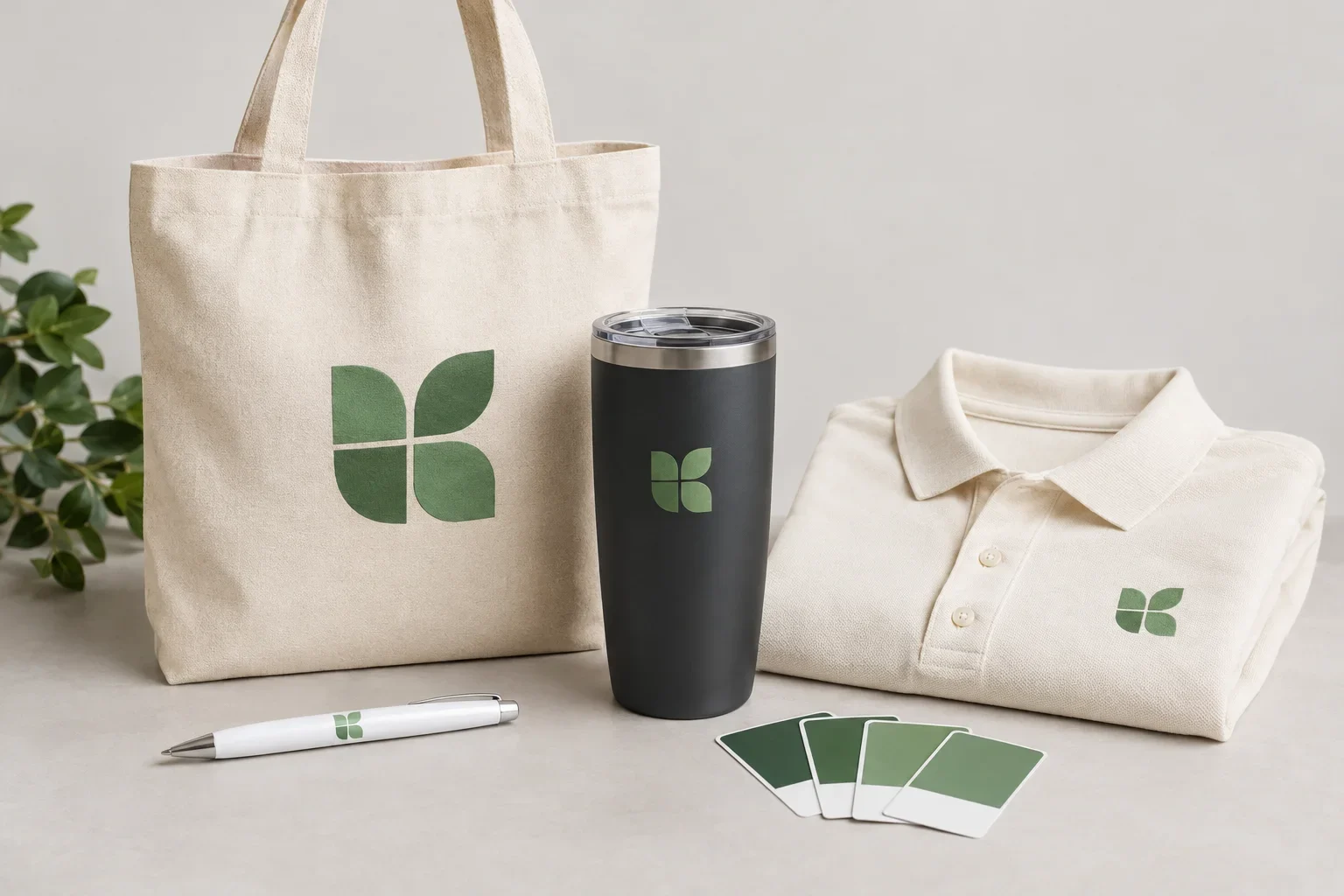
Imagine you're ordering a coordinated promotional collection with the same green logo on four products.
1. A White Plastic Pen
The pen may use pad printing or another method that applies ink directly to its surface.
If the supplier offers custom PMS matching for that particular pen, a specially mixed ink may help reproduce your green closely.
But if the pen only offers standard imprint colors, you may need to choose the closest available green.
2. A Natural Cotton Tote Bag
The tote bag may be screen printed using ink applied to woven cotton.
Cotton has texture, and the natural color of the fabric can influence the appearance of printed ink.
Even if the printer uses an ink mixed to your requested Pantone color, the finished green may look slightly different from the same ink printed on smooth white plastic.
3. A Powder-Coated Stainless Steel Tumbler
The tumbler may offer screen printing, pad printing, full color digital printing, or another available decoration method.
Its coating, surface color, and printing process can affect the final appearance.
If the tumbler is dark blue or black, reproducing your green logo may involve different considerations than printing it on a white surface.
4. An Embroidered Polo Shirt
Embroidery uses thread instead of ink.
The decorator may use your Pantone color as a reference when selecting thread, but the closest available thread color may not be an exact match.
Thread texture and the direction of the stitches can also change how the color appears under different lighting.
Same brand color, different physical results
Your pen, tote bag, tumbler, and polo can all follow the same brand color guidelines while showing slight differences in the finished logo. That's a normal consideration when decorating different materials using different production methods.
Which Decoration Methods Offer the Best Color Matching?
Different decoration methods provide different levels of control over the finished color.
There isn't one method that's automatically best for every logo. The right choice depends on the product, artwork, and available decoration options.
Spot Color Screen Printing
Traditional screen printing often uses individual ink colors, making it a useful method for logos with one or more solid colors.
When a supplier offers custom PMS matching, ink can sometimes be mixed to target a specific Pantone shade.
This can provide more direct control over a solid brand color than relying on a standard process-color approximation.
However, exact matching capabilities still depend on the ink system, product material, and supplier.
Pad Printing
Pad printing is common on smaller or curved promotional products, including pens and certain hard goods.
Some pad printing suppliers support custom PMS ink matching, while others offer only standard imprint colors.
The size and shape of the product can also influence how the imprint appears.
Full Color Digital Printing
Full color digital printing can reproduce artwork containing many colors, gradients, and detailed graphics.
Instead of necessarily using a separate specially mixed ink for each brand color, the printer typically creates colors through combinations of available inks.
Some Pantone colors can be reproduced closely, while others may fall outside the printer's available color range.
A full color method can be an excellent choice when your logo requires multiple colors or detailed artwork, but it should not automatically be considered an exact PMS matching process.
Full Color Transfers
Full color transfers are frequently used for apparel and bags when a design contains multiple colors, gradients, or complex details.
Color reproduction depends on the transfer printing process, inks, transfer material, fabric, and application method.
Even if the design is created using exact brand color values, some variation may occur in the final transfer.
Embroidery
Embroidery colors are selected from available thread shades.
A Pantone number can help identify the desired color, but thread colors are not infinitely adjustable like mixed printing inks.
In many situations, the decorator selects the closest available thread color.
Laser Engraving and Debossing
These methods generally create their appearance through the product material itself rather than applying colored ink.
Laser engraving may expose an underlying metal surface or create a contrast mark in the material or coating.
Debossing creates a recessed impression in the product surface.
These methods can look attractive and professional, but they are not usually used to reproduce a specific Pantone ink color.
For more information about your decoration options, read which decoration method should I choose?
Custom PMS Matching vs. Standard Imprint Colors
One important distinction when ordering promotional products is whether a supplier offers custom color matching or only a predetermined selection of imprint colors.
Two Common Color Options
The available options depend on the exact product and decoration method.
Custom PMS Color Matching
When available, ink is prepared to target a specific Pantone color.
- Useful for established brand colors
- May provide closer control over solid ink colors
- Not available for every product
- May involve additional charges
- Can have quantity or production requirements
Standard Imprint Colors
The supplier offers a selection of predetermined ink colors.
- Common on many promotional products
- Simple to select during ordering
- May include colors close to your brand
- Exact Pantone matching may not be available
- The selection varies by product and supplier
For example, a product may offer standard red, royal blue, navy, green, black, and white imprint colors.
If your company green is close to the supplier's standard green, you may decide that the standard option is acceptable.
If your brand requires a very specific green, you may want to look for a product and decoration option that supports custom PMS matching.
The important thing is to understand which option you're selecting before production.
Does Custom Color Matching Cost More?
It can.
Some suppliers include certain ink matching capabilities within their standard decoration pricing.
Others charge an additional fee for custom PMS matching because it requires special ink mixing, preparation, or production handling.
Additional minimum quantities or other requirements may also apply.
There is no universal PMS matching charge across the promotional products industry.
Costs and availability depend on the supplier, product, and decoration method.
When exact matching isn't essential
For a large event giveaway, a close standard ink color may be perfectly acceptable. For a carefully controlled corporate brand program, custom color matching may be worth considering when available. The right choice depends on how important that specific color is to your organization.
Can You Match the Color of the Product Itself?
This is a different question from matching the color of your printed logo.
Let's say your company's official color is a particular shade of turquoise.
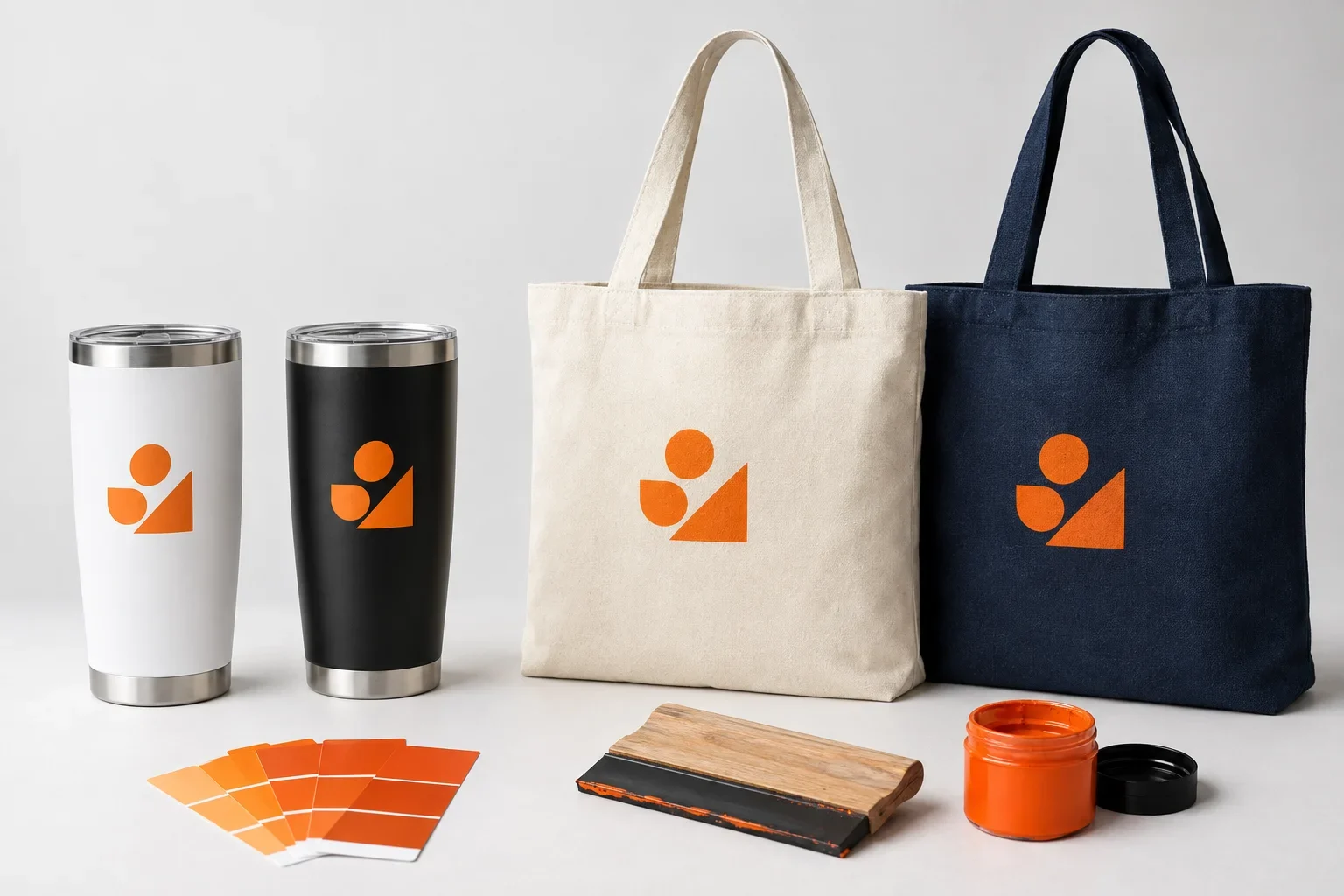
You want to order stainless steel water bottles in that exact turquoise, with a white logo printed on them.
Even if the white logo is easy to reproduce, the bottle itself may not be manufactured in your particular turquoise.
Standard promotional products are generally offered in a selection of colors chosen by the manufacturer.
A product may come in teal, aqua, navy, black, white, and several other colors, but that doesn't mean the manufacturer offers every possible Pantone shade.
Manufacturing a product in a custom color is a separate process that may require special production arrangements, higher quantities, additional costs, or longer lead times.
Product color and logo color are separate things
Custom ink matching applies to the decoration on a product. It does not automatically mean the product itself can be manufactured in your brand color. Product color availability is determined by the manufacturer, while imprint color options depend on the available decoration methods.
Why Dark Products Can Make Color Matching More Complicated
Printing a light or bright logo on a dark product can introduce additional considerations.
For example, a bright yellow logo printed on a white pen may appear different from the same yellow printed on a dark blue tote bag.
The underlying product color can influence how the ink appears, especially if the ink is not fully opaque.
Some decoration processes use an underbase or other preparation to help lighter colors appear properly on dark materials.
However, not every product or printing method uses the same approach.
Fabric texture, ink opacity, product coating, and surface finish can all affect the final result.
This is another reason why a logo color may look different when printed on light and dark products, even when the intended color specification is identical.
What If My Brand Colors Are RGB, CMYK, or HEX Instead of Pantone?
That's common, especially for businesses whose branding was originally developed for websites or digital marketing.
You may have brand guidelines listing RGB values, CMYK percentages, or HEX color codes rather than Pantone numbers.
These values can still be useful because they communicate the intended colors.
However, converting an RGB, CMYK, or HEX value to a Pantone color is not always exact.
Different color systems have different capabilities, and the appearance can vary based on color profiles and the final printing process.
If you only have digital color specifications, provide them along with your original artwork.
There's no need to guess at a Pantone number before asking about the available options.
For a better understanding of these color systems, read RGB vs. CMYK.
Can You Match Colors From a Screenshot or Photograph?
A screenshot or photograph can be helpful for showing the general color you're trying to achieve.
However, it isn't a reliable way to specify an exact printing color.
Photographs are affected by lighting, camera settings, editing, compression, and the colors of surrounding objects.
Screenshots can also look different depending on the device displaying them.
For example, photographing a blue business card under warm indoor lighting may make it appear more purple or muted than it does in person.
If precise color matching matters, official brand guidelines or physical color references are generally more useful than photographs.
What Information Should I Provide for Brand Color Matching?
You don't need a complicated print specification document to order promotional products.
But if your company has established branding, a few details can make the process easier.
Helpful Brand Color Information
Provide what you have. Not every item is required for every order.
Original Logo Files
Vector files such as AI, EPS, SVG, or vector PDF are usually the best starting point.
Pantone References
Include official PMS numbers if your company has them.
Brand Guidelines
Share approved logo versions, color specifications, and any relevant branding requirements.
Color Priorities
Let us know whether a close match is acceptable or if precise color reproduction is especially important.
If you're unsure which artwork files are best, read what file types can I upload?
What If Exact Color Matching Is Extremely Important?
Some organizations have strict brand standards and require promotional products to follow approved color specifications as closely as possible.
This is especially common for established corporate brands, franchises, universities, and organizations with detailed branding guidelines.
If your project has strict color requirements, communicate that before production.
Depending on the product, it may be worth reviewing:
- Whether custom PMS ink matching is available
- Whether the supplier uses standard inks or process-color printing
- Whether the selected material affects color reproduction
- Whether a different available decoration method offers more suitable color capabilities
- Whether a physical pre-production sample can be produced
- Whether additional color approval options are available
- Whether custom color matching involves additional charges or minimum quantities
A physical sample may be especially useful when the exact appearance of the finished decoration matters.
However, samples and additional color approval services are not available for every promotional product, and they may involve additional cost or time.
It's important to determine these options before the order moves into production.
Will My Digital Proof Show the Exact Brand Colors?
Not necessarily.
A digital artwork proof is displayed on a computer, tablet, or phone.
Those devices use light to display colors, and the appearance can vary depending on screen settings, brightness, and color calibration.
A digital proof is useful for confirming artwork placement, logo size, layout, spelling, and listed color specifications.
It generally should not be treated as an exact physical representation of printed ink, embroidery thread, engraving, or product materials.
If your proof includes a specific Pantone number, review that specification rather than relying entirely on how the color appears on your monitor.
If something is unclear, ask before approving the proof.
For more information, read what is a print proof?
How Purple Pie Promos Helps With Color Matching
When you order custom promotional products, you shouldn't have to become an expert in ink mixing, color profiles, printing equipment, and thread catalogs.
That's part of what we're here to help with.
Purple Pie Promos reviews your artwork, selected product, imprint area, and decoration method before production.
If you provide Pantone colors or other brand specifications, those details can be considered alongside the product's available decoration options.
If the selected method does not support your requested color requirements, we'll help explain the available alternatives before the order moves forward.
That may mean reviewing an available standard ink color, considering custom PMS matching when offered, or discussing another suitable product or decoration option.
The goal is to help you make an informed decision before production, rather than discovering an unexpected color difference after your products arrive.
A Practical Color Matching Process
From your brand guidelines to the approved decoration specifications.
Common Brand Color Matching Mistakes
Most color matching problems start with expectations that don't account for the differences between printing methods and product materials.
Here are some common mistakes worth avoiding:
- Assuming the same Pantone number will look identical on every product material.
- Expecting every promotional product to offer custom PMS matching.
- Choosing a standard imprint color without checking whether it is close enough to your brand color.
- Assuming full color digital printing guarantees an exact Pantone match.
- Expecting embroidery thread to look identical to printed ink.
- Using a screenshot or phone photograph as the only color reference when precise matching matters.
- Confusing custom imprint ink matching with custom manufacturing of the product color.
- Ignoring how dark product colors and different surfaces affect the final imprint.
- Approving a digital proof based only on how the colors appear on a computer screen.
- Waiting until after production begins to communicate strict brand color requirements.
For more information about printing differences, read why do colors look different on products?
Frequently Asked Questions About Brand Color Matching
Can you match my logo's Pantone colors exactly?
Some products and decoration methods support custom PMS ink matching, which can produce a close match to a specified Pantone reference. However, exact matching cannot be guaranteed for every product, material, or printing process.
Can you match my logo colors if I don't know the Pantone numbers?
You can provide your original logo files, brand guidelines, or other available color information. These can help identify the intended colors and determine which reproduction options are available.
Will my logo color look the same on a pen and a shirt?
Not necessarily. Pens and shirts may use different materials and decoration methods. Even when the same intended color is specified, the finished appearance can vary.
Does full color printing mean my logo will match perfectly?
No. Full color printing can reproduce many colors, gradients, and detailed graphics, but it does not guarantee an exact match to every Pantone or RGB color. The available color range depends on the printing equipment and process.
Can embroidery thread match Pantone colors?
Pantone references can be used to select an appropriate thread color, but embroidery is limited to available thread shades. An exact equivalent may not exist.
Can I order promotional products in my exact company color?
Standard products come in manufacturer-selected colors. Custom manufacturing in a particular brand color may be possible for certain products, but it is a separate process that can involve special quantities, costs, and lead times.
Does custom PMS matching cost extra?
It may. Some suppliers charge additional fees for custom ink matching, while others include certain matching options in their standard decoration pricing. Costs vary by product and supplier.
Can I see a physical sample before ordering?
You can ask whether a decorated pre-production sample is available. Sample availability, charges, and production timing vary by supplier and product.
Brand Color Checklist Before Ordering
If consistent branding is important for your promotional products, review these details before approving your order.
- Send your original logo artwork whenever possible.
- Provide official Pantone colors or brand guidelines if available.
- Identify which logo colors are especially important to match.
- Check whether the selected product supports custom PMS matching.
- Understand whether the decoration uses standard ink colors, custom-matched ink, digital printing, or another process.
- Consider how product color, material, and texture may affect the imprint.
- Confirm any additional color matching fees or production requirements.
- Ask about physical samples when precise color appearance is critical.
- Review the color specifications listed on your artwork proof.
- Make sure any questions or concerns are addressed before approving production.
For more artwork preparation tips, visit our artwork checklist before ordering.
The Bottom Line
Matching your brand colors on promotional products is often possible, but the level of accuracy depends on the product, material, decoration method, and supplier capabilities.
Pantone colors provide a valuable reference for consistent branding, especially when custom ink matching is available.
However, standard imprint colors, full color digital printing, embroidery, and other decoration methods reproduce colors differently. The same intended shade may not look identical on every material.
The best approach is to provide your official brand color information, understand the available decoration options, and communicate any strict matching requirements before production.
Consistent branding starts with the right color information
Your Pantone colors, original artwork, and brand guidelines help establish the intended result. The selected product and decoration method determine how closely that color can be reproduced.
Have a specific color you need to match? Purple Pie Promos can help review the available options before your order moves forward.
Need help matching your company colors?
Purple Pie Promos can help review your logo, brand color specifications, product selection, and available decoration options. Whether you have exact Pantone numbers or just your original artwork, we'll help you understand what's possible before production.
Request Brand Color Help